
Outdoor Living, Audio & Landscape Lighting
The back of the house is where a lot of Long Island homes actually live, and it is usually the part the technology forgot. Speakers that were never rated for weather. A television that washes out by two in the afternoon and dies the first winter. Path lights on a photocell that come on at different times. We treat the outside of a property the same way we treat a commercial building: work out what it has to do, design for the conditions it lives in, and run the infrastructure properly the first time so the finished result looks like nothing was installed at all.
What’s included
- Outdoor speaker layout designed for coverage at conversation volume rather than volume at one spot — landscape satellites, buried subwoofers, and hardscape or rock-mount enclosures
- Weather-rated and full-sun outdoor televisions specified by actual mounting location, with brightness matched to whether the screen sits in shade, partial sun or open sky
- Outdoor zones that run on the same system and the same control as the audio inside the house
- Landscape and architectural lighting design — fixture selection, beam angles, colour temperature and layout drawn from the planting plan and the elevation, not spaced evenly along a path
- Low-voltage lighting infrastructure: transformer sizing with headroom, direct-burial cable runs, and connections made to survive being wet
- Lighting control and scenes brought onto the same interface as audio and shades where the platform supports it
- Outdoor network coverage — hardened, properly grounded access points so streaming works at the far end of the yard
- Concealed pathways and outdoor-rated enclosures, sized so equipment can be serviced without dismantling the installation
Equipment
What we specify outdoors, and why.
We are authorized TruAudio dealers, so outdoor audio gets specified from a range built for it rather than assembled from whatever is in stock. The decision that drives most of a design is 70 volt distribution: on a large property it lets a single run feed a dozen satellites at sensible levels, instead of the impedance arithmetic and cable gauge that low-impedance wiring forces at distance.
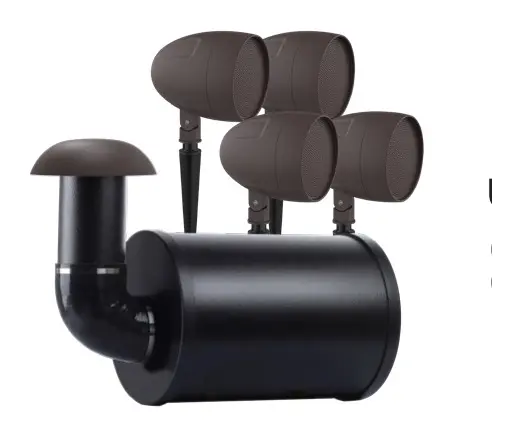
Complete landscape system
TruAudio UltraScape10
A burial subwoofer and four satellites off a single two-channel amplifier, expandable to eight satellites and two subs as a property grows. The starting point for most yards.
- Subwoofer
- 10" dual voice coil, buried
- Response
- 45 – 200 Hz (±3 dB)
- Expandable to
- 8 satellites, 2 subs
- Amplifier
- Most 2-channel amps
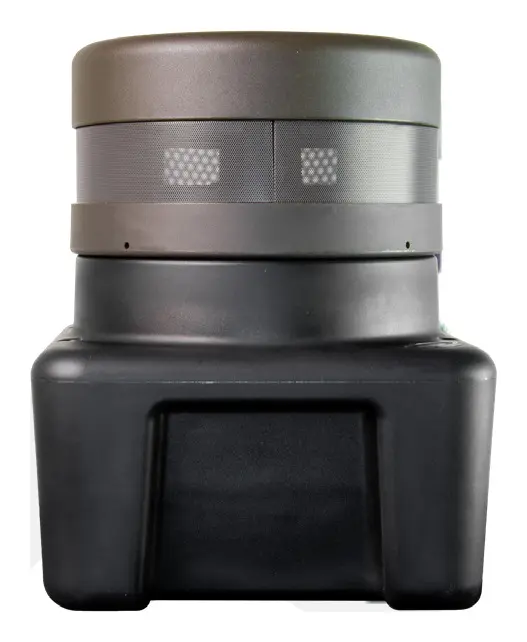
Buried subwoofer
TruAudio SubTerrain ST-12PRO
Where the low end has to disappear entirely. Sealed against water intrusion, with the driver at the top of the chamber so it can be serviced without excavating the whole unit — which is the part that matters five years in.
- Woofer
- 12", 400 W
- Impedance
- 70 V or 4 Ω · 200 W taps
- Response
- 30 – 120 Hz
- Max SPL
- 110 dB at 70 V
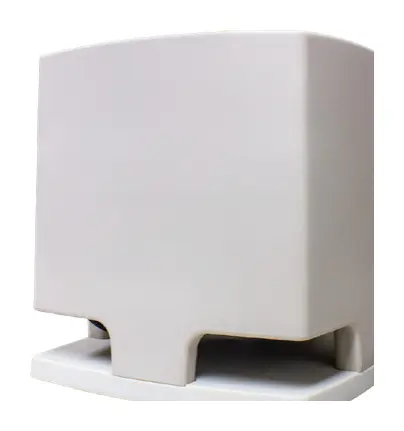
Above-grade subwoofer
TruAudio Hardscape HS-SUB-12
For properties where burying a sub is not an option — over a slab, inside an outdoor cabinet, or tucked into planting. Same job as the SubTerrain, no excavation.
- Woofer
- 12" polypropylene
- Impedance
- 4 Ω or 70 V · 200 W taps
- Response
- 36 – 150 Hz
- Rated
- IP66, humidity rated
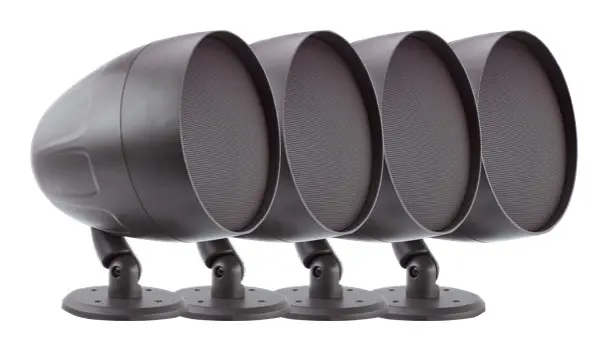
Landscape satellites
TruAudio AS-2
The workhorse. Distributed through planting beds and along hardscape so coverage is even at conversation volume rather than loud in one spot. The 70 V taps are what make a large property practical on one run.
- Driver
- 6.5" woofer, 1" silk dome
- Impedance
- 8 Ω or 70 V / 100 V
- 70 V taps
- 3, 6, 13, 25, 50 W
- Rated
- IP66, aluminium mesh grill
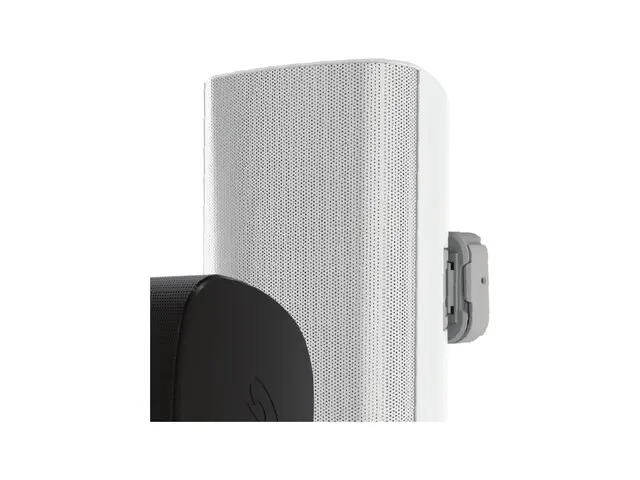
Wall-mount outdoor speaker
TruAudio OP6
For a covered porch, a soffit or a wall where a landscape satellite has nothing to sit in. The mounting plate takes the wire termination first, so the speaker goes on, gets aimed and locks — a real difference on a ladder.
- Driver
- 6.5" woofer, 1" aluminium
- Bass
- Passive radiator
- Power
- 25 – 150 W · 8 Ω
- Finish
- White or black
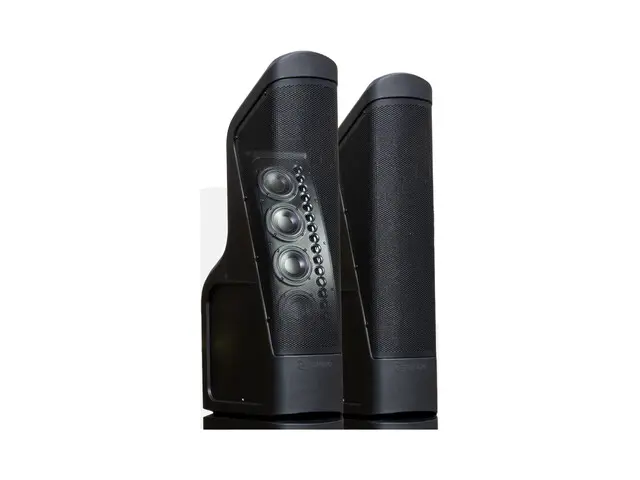
Line array bollard
TruAudio Tempest Tower
Sixteen tweeters in a curved line array over an integrated bandpass subwoofer, in a bollard that can be buried in a bed or base-plated on a deck. Where one position has to cover a large space evenly for people both seated and standing.
- Array
- 16 × 1" + 4 × 4"
- Subwoofer
- 10" bandpass, waterproof
- Response
- 37 Hz – 20 kHz (−3 dB)
- Power
- 200 W · 4 Ω
Product images above are supplied by the manufacturer and show the equipment itself, not our installations. Photographs of our own work are on The Work. TruAudio, Origin Acoustics, VSSL and their product names are trademarks of their respective owners.
Outdoor Audio That Carries Without Shouting
Outdoor sound has no walls and no ceiling to help it, which is why one pair of speakers bolted to the back of the house never works. There is no reflected energy, so level drops off far faster than it does indoors, and the usual response is to turn it up — which fixes nothing near the far end of the patio and makes the seating nearest the speakers unusable. It also makes you the reason a neighbour complains.
The fix is more sources at lower level. Small satellites distributed through the planting beds and along the hardscape put even coverage across the whole area at conversation volume, and a buried subwoofer restores the low end that open air strips out. Placement follows where people sit and stand, not where the cable was easiest to pull.
Where distributing that many locations is not practical — a courtyard, a roof deck, a property where nothing can be buried — a line array bollard does the job from a single position instead, throwing evenly across a wide area for people both seated and standing.
Everything outside has to survive being outside. That means speakers and enclosures actually rated for it, direct-burial cable, and connections made to stay sealed when they are wet.
It also means the amplification lives somewhere protected, rather than in a box on an exterior wall that will fill with water in year two. Origin Acoustics and TruAudio, both lines we are authorized dealers for, build landscape and hardscape speakers designed for exactly this — we specify from them instead of putting an indoor speaker under an overhang and hoping.
Outdoor Television, Specified for the Actual Spot
An outdoor television is not an indoor television in a case. Two things decide whether it works: brightness relative to the light hitting the screen, and whether the chassis can handle the temperature swing and the moisture where it hangs.
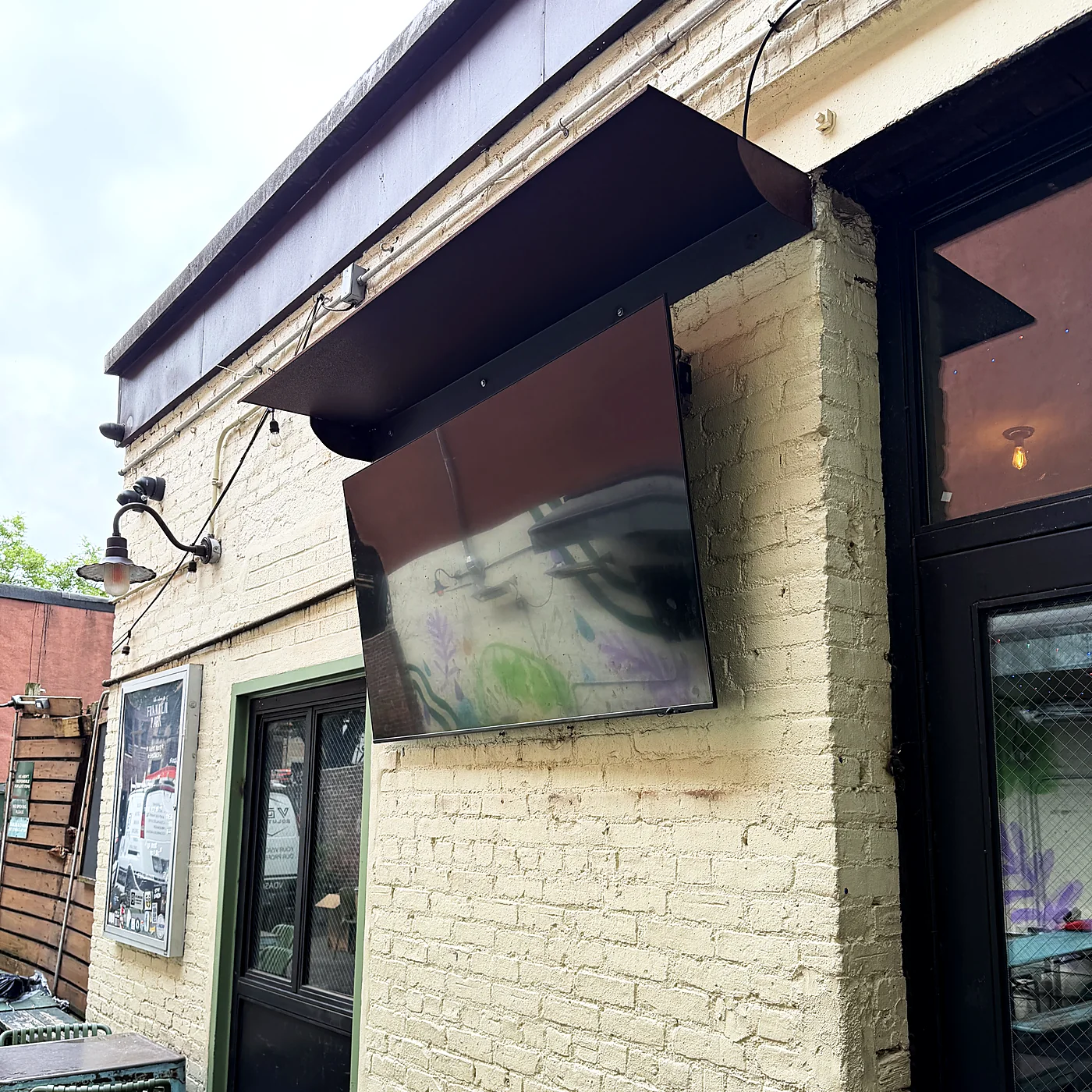
The brightness question is settled by the mounting position, not by the room. A screen under a solid roof on a north-facing porch needs far less output than one on an open pergola facing west into afternoon sun, and the difference in specification between the two is significant. Getting it wrong is expensive in a way that only shows up on the first bright afternoon, and no settings menu recovers it.
The environmental question is about the whole install, not just the panel. The mount has to hold in wind and stay serviceable. The connections need to be in a rated enclosure. Cable has to reach the source rack indoors, which is a decision made before the surface is closed up.
And control has to work from outside. A remote that needs line of sight to a receiver in the basement is not control, which is why the source routing and the interface get scoped at the same time as the screen.
Buried or Above Grade
The subwoofer is the decision that most often gets made by accident, and there are only two answers. A buried sub disappears completely — the enclosure goes in the ground and a vented cap sits at grade, so the low end comes from nowhere in particular, which is exactly the effect you want.
Where burying is not possible — over a slab, through a root system, in a courtyard with no soil to open — a hardscape sub does the same job above ground. It is designed to be tucked into planting, set inside an outdoor cabinet, or placed against a wall where it reads as part of the hardscape rather than as equipment.
The practical question is servicing. On a buried sub the driver should be reachable from the top without excavating the whole unit, because at some point somebody will need to get at it. That is a specification decision made on day one, and it is invisible until the day it matters.
Landscape Lighting Design
Landscape lighting is a service we are building out, and we would rather say that plainly than imply a portfolio we have not shot yet. What we bring to it is the discipline the rest of our work runs on: low-voltage infrastructure done properly, control integration, and a design worked out before anything is bought.
Good exterior lighting is a design decision, not a product decision. It starts from what the property should look like at night — which trees are worth uplighting, where the architecture has depth worth revealing, where people need to see their footing — and works backwards to fixtures, beam angles and colour temperature. Fixtures spaced evenly along a path at the same output light the path and nothing else, and they read as a lighting installation rather than as a lit property.
The infrastructure decides whether it still works in five years. Transformers sized with real headroom rather than to the exact load. Runs calculated so voltage at the last fixture is inside specification instead of dim. Direct-burial cable and connections made to stay sealed. And a consistent colour temperature across the whole property, because mismatched warmth is the single most obvious sign of a system that was extended piecemeal.
Where the property already has a control platform, lighting scenes belong on it — the same interface that runs audio and shades, so an evening setting is one action rather than four. Which fixtures and controllers integrate cleanly depends on the specific hardware, and we confirm that before committing to it rather than after.
Run the Infrastructure While the Walls Are Open
Nearly everything on this page is dramatically cheaper before a project is finished. Speaker cable to the patio, conduit under the hardscape, a data run to where the outdoor television will hang, a sleeve under the new driveway — each of these is minutes of work during construction and a demolition conversation afterwards.
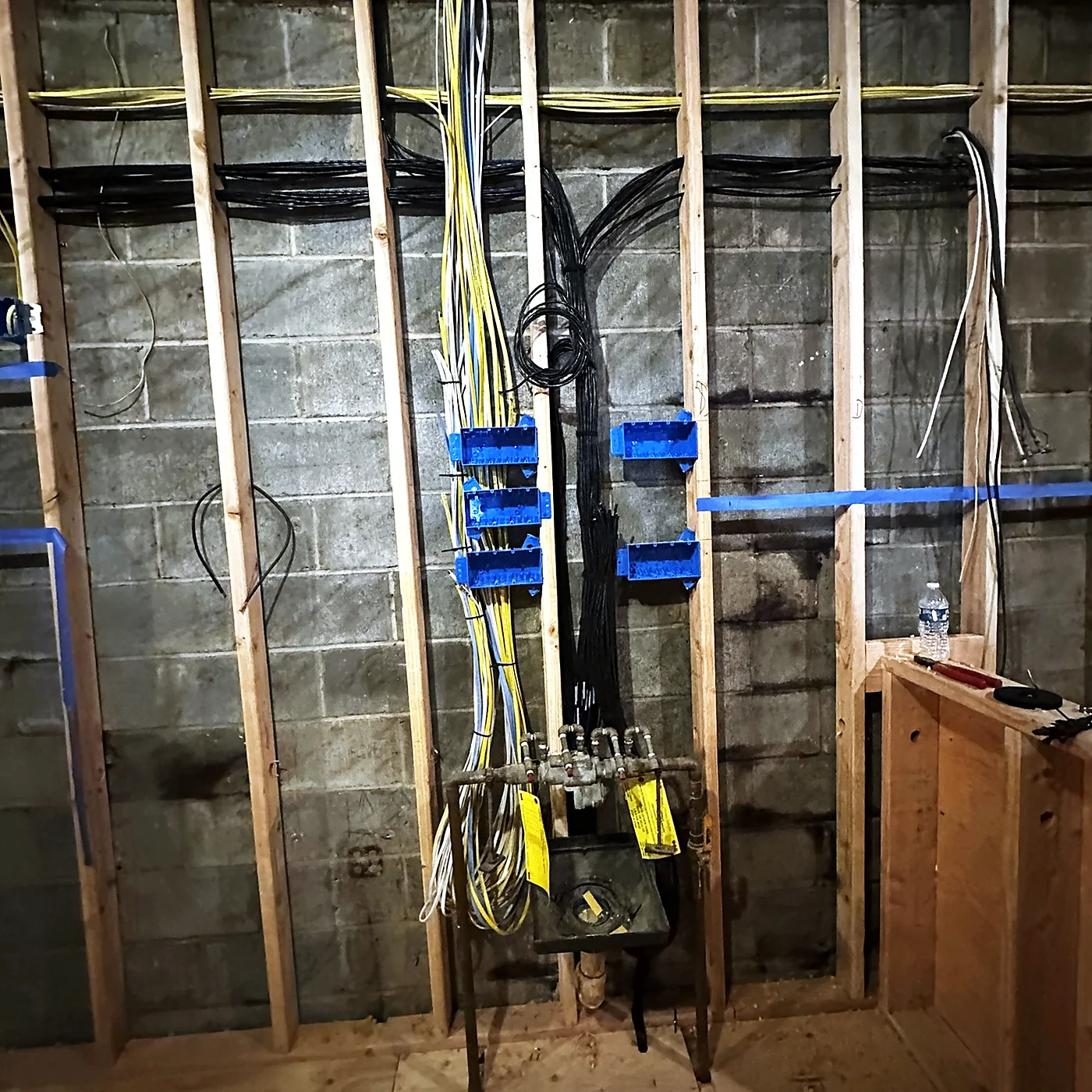
That is the single most useful thing we do on a renovation or a new build: get in early enough to put pathways where they will be needed, including for things the owner has not decided on yet. A capped conduit and a coil of cable cost almost nothing now and mean the answer in three years is yes.
It is also why we would rather talk to the general contractor, the landscape architect or the pool builder while the plan is still on paper. Coordinating low-voltage against the planting plan, the hardscape layout and the electrical rough-in is a scheduling problem when it happens on time and a rework problem when it does not.
Common questions
Outdoor Living & Landscape Lighting: what clients ask before they book
Can regular indoor speakers be used outside under a covered porch?
It is common and it fails eventually. Humidity, temperature swing and salt air near the shore attack the surround and the drivers even when rain never reaches the speaker. Outdoor-rated models cost more because of what they are built from, and on Long Island in particular that is the part doing the work.
How many outdoor speakers does a patio actually need?
More than most people expect, at lower volume each. Outdoors there is no ceiling or wall to reflect sound, so level drops off quickly and a single pair means one loud area and one inaudible one. Several small satellites distributed through the space produce even coverage at conversation volume — and generally end up quieter at the property line, not louder.
Do you need a special television for outdoors, or will a normal one do?
For anything beyond a fully enclosed, climate-controlled space, an outdoor-rated screen is the right call. The two things that matter are brightness relative to the light hitting the screen and whether the chassis handles the temperature and moisture where it hangs. Full-sun locations need substantially more output than shaded ones, and that decision is made from the mounting position rather than from the room.
Do you install the landscape lighting itself, or only the control?
Both — we design and install the lighting, including the low-voltage infrastructure, and integrate the control where there is a platform to integrate with. It is worth being straight with you that landscape lighting is a newer part of our business than the audio and video work is. We are happy to walk a property and show you the design approach before you commit to anything.
When in a renovation should this get scoped?
As early as possible, and certainly before walls close or hardscape goes down. Speaker cable, conduit for outdoor television, sleeves under paving and a data run to the far end of the yard are trivial during construction and disruptive afterwards. Even where a decision has not been made, putting a capped pathway in costs very little and keeps the option open.
Can outdoor audio, television and lighting run from one interface?
Usually, yes, when the devices support IP, serial or IR control. The value is in the presets rather than the novelty — one evening setting that brings up the landscape lighting, starts music in the pool zone and leaves the rest of the property alone. Which specific hardware integrates cleanly varies, so we confirm it during design instead of promising it up front.
Rooms we do this in
Related services
Whole-Home & Distributed Audio
Music in every room that matters, on a system with real zones and real sources — and speakers that either disappear into the ceiling or are not visible at all.
Home Theater & Media Rooms
Dedicated theaters and everyday media rooms — designed around the seating and the room, not around a box of equipment, and controlled by something anyone in the house can use.
Networking & Enterprise WiFi
Segmented, commercial-grade networks and wireless designed around what the building actually runs — point of sale, cameras, phones, staff and guests — instead of a single flat network that everything fights over.
Tell us what you're trying to solve.
Free on-site estimates across Suffolk and Nassau County. We look at the space and tell you what it needs — and what it doesn't.
System down and need service now? Call (949) 969-3345 — Monday – Friday, 10am – 6pm.