
Commercial Video & TV Distribution Systems
A wall of televisions is easy. A wall of televisions where a bartender can put the Yankees on the four screens over the rail and the Jets on everything else, in about six seconds, during a rush, is the actual job. We build video distribution for bars, restaurants, and venues throughout Long Island, from source rack through cabling and mounts to the control interface that decides whether the system gets used or ignored.
What’s included
- Matrix switching design so any source can reach any display, sized with spare inputs and outputs for later additions
- HDBaseT distribution over Cat6 for long runs, and AV-over-IP encoders and decoders where display counts keep growing
- Source rack build housing satellite and cable receivers, media players, and streaming devices with clean power and cooling
- DirecTV for Business and commercial cable integration, including receiver-per-zone planning and channel mapping
- Touchscreen and tablet control with real channel logos and TV names, not input numbers
- Display selection and mounting including tilt, articulating, ceiling drop, and back-to-back configurations
- High-brightness outdoor displays and weather-rated enclosures for patios, decks, and covered bars
- Audio hand-off so game audio can be routed to a specific sound zone rather than the whole building
One Rack, Many Screens
The core of a multi-TV venue is centralizing sources. Every satellite receiver, cable box, media player, and streaming stick lives in one rack in the back, on conditioned power, ventilated, and locked. Nothing hangs behind a television, nothing needs a remote pointed at it, and nobody has to climb a ladder because a box lost its signal.
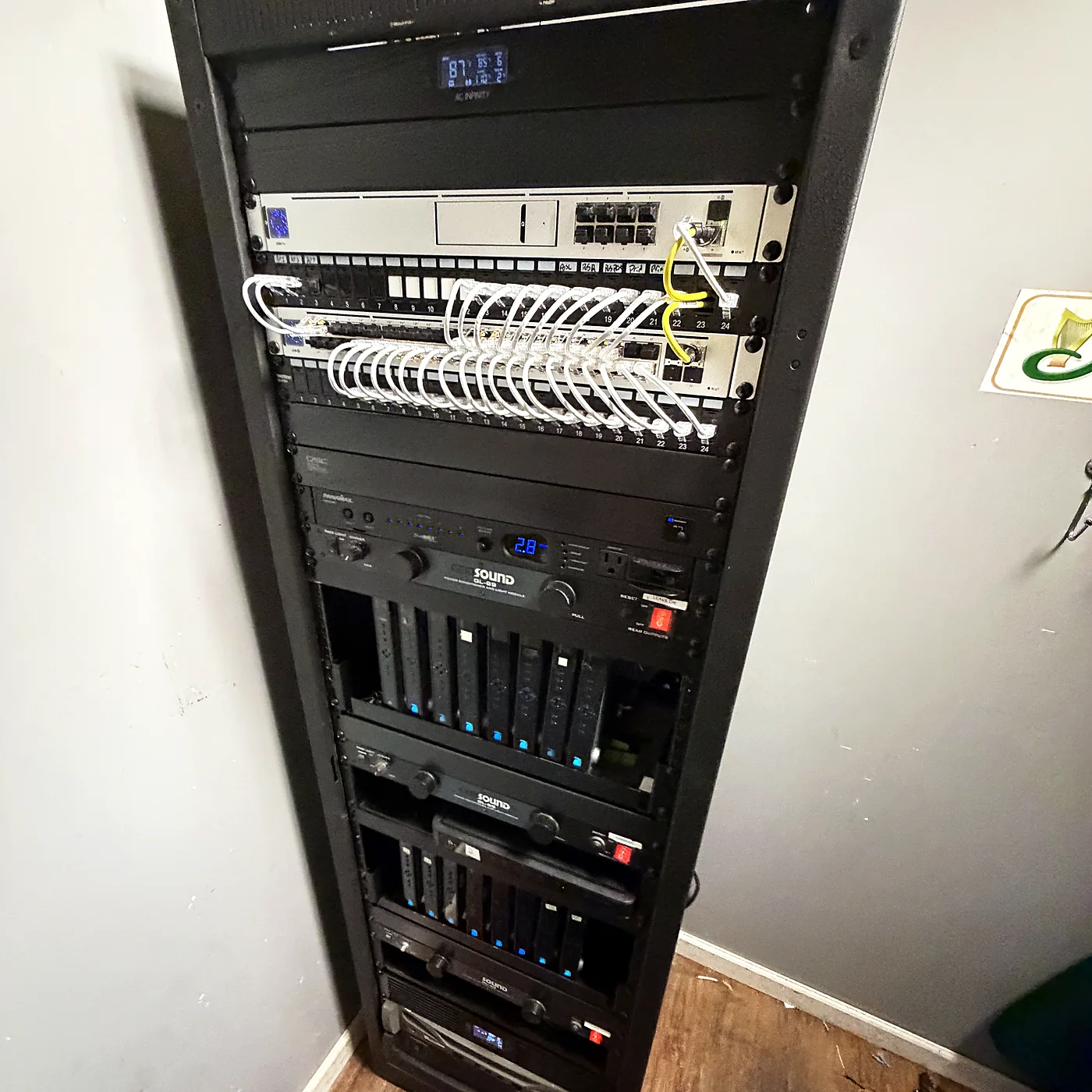
From that rack, video is distributed to each display over structured cabling. HDBaseT extenders push HDMI plus control over a single Cat6 run to a hundred meters or more, which covers most bars, restaurants, and single-floor venues comfortably. The cable pathways matter as much as the electronics, so we plan runs during rough-in whenever the buildout timeline allows.
Matrix Switching or AV Over IP
A traditional HDMI matrix is a fixed box with a set number of inputs and outputs. Eight sources to sixteen displays, for example. It is simple, latency is effectively zero, and for a stable venue with a known screen count it is often the right call. The limit is that when you outgrow it, you replace it.
AV over IP puts an encoder on each source and a decoder at each display, all riding a managed network switch. Adding the fourteenth television means adding one decoder, not buying a bigger matrix. It also scales across floors and buildings. The trade is that the network becomes part of the AV system, which means proper switch selection, VLANs, and multicast configuration rather than whatever switch was in the closet.
We pick based on where the venue is headed. A restaurant with six screens and no expansion plans gets a matrix. A multi-level bar that is already talking about the roof deck gets IP.
The Bartender Test
Here is the failure mode we get called about most: a regular asks for a specific game on the TV above their seat, and nobody working that night knows how to do it. The staff calls the owner, the owner calls the integrator, and meanwhile someone is pointing a universal remote at the ceiling.
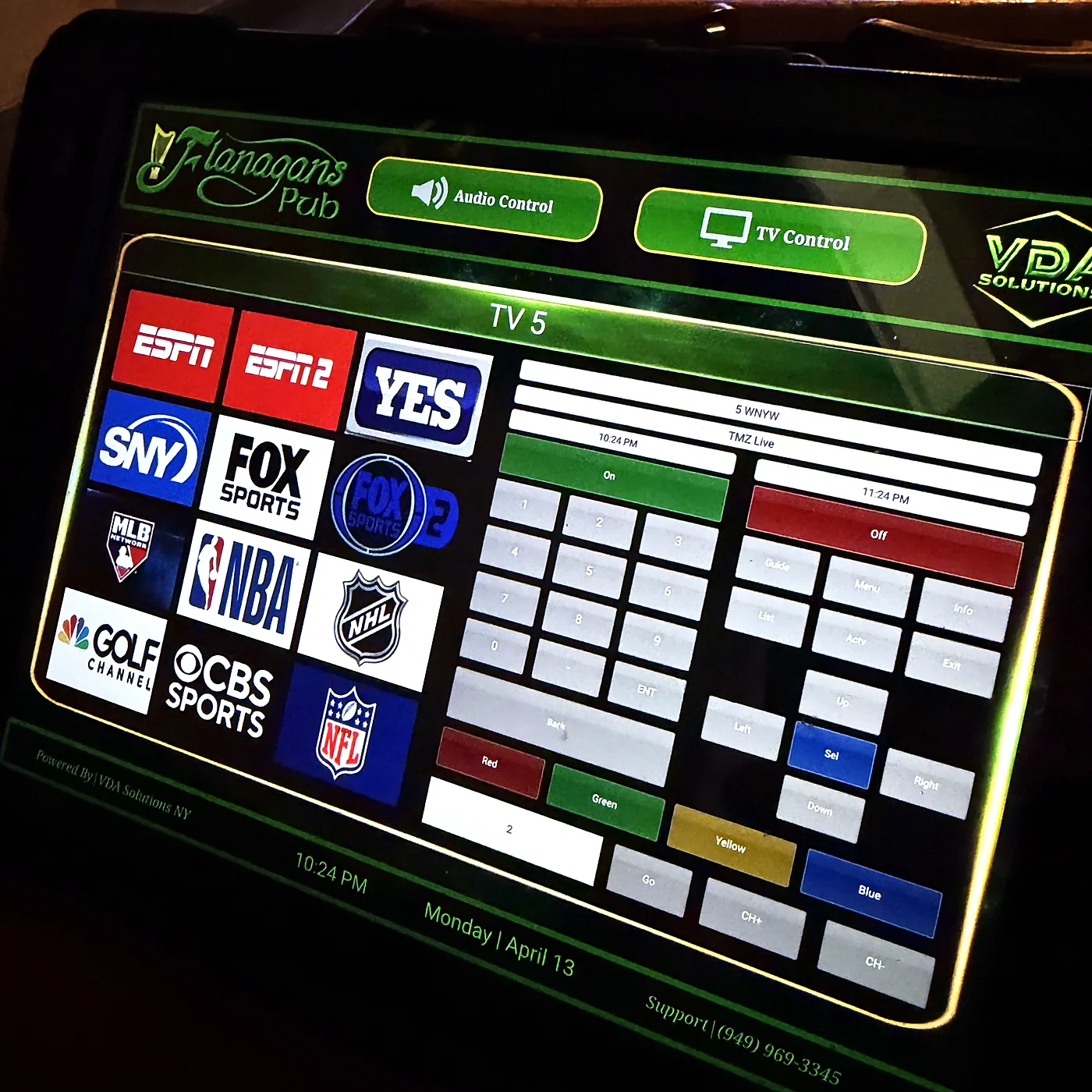
The fix is a control interface built around how a bar actually operates. A wall-mounted touchscreen or tablet shows a floor-plan style layout with the televisions named the way staff names them, plus channel buttons with real logos for ESPN, YES, MSG, FOX Sports, NFL Network, and whatever else your crowd asks for. Tap the TV, tap the channel. Done.
We build in presets too, because most nights are one of a few patterns. A Sunday preset that pushes the early game to the main bar and RedZone to the back. An all-screens-one-game preset for a title fight. A closing preset that shuts every display and the source rack down at once. Presets get named by what they do, and we train the staff on them before we leave.
Satellite, Cable, and What Feeds the Screens
Commercial venues need commercial accounts. DirecTV for Business and commercial cable service are licensed for public display and priced by occupancy and room type, and residential service is not a legal substitute in a bar. We work with your existing provider account, coordinate the receiver count you need for independent channel viewing, and integrate the boxes into the rack and the control system.
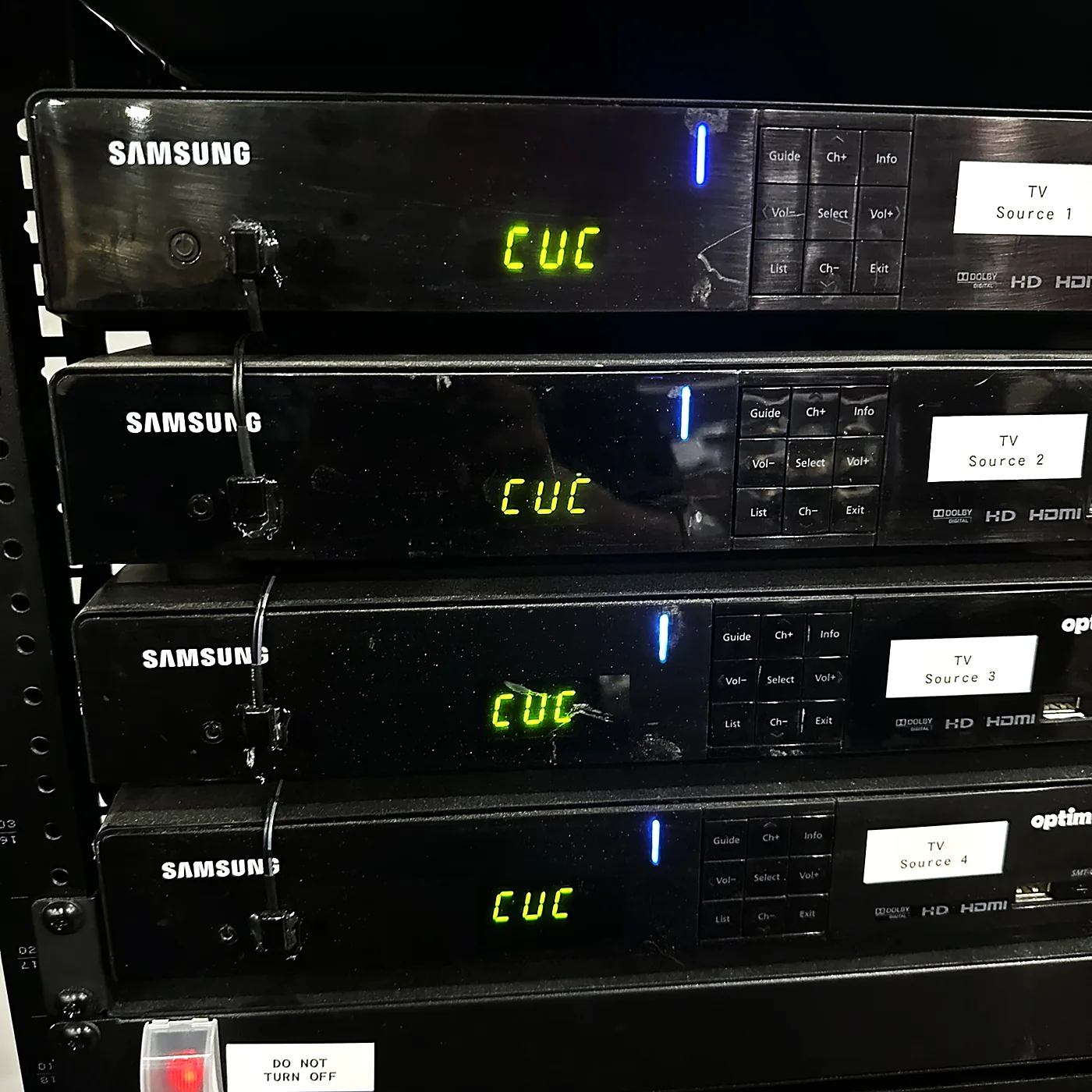
How many receivers you need comes down to how many different channels can be on at once. Every independently tunable channel needs its own receiver or its own tuner, so a venue that wants six simultaneous different games needs six sources feeding the matrix. We size that with you rather than discovering it on opening weekend.
Outdoor Displays That Survive Long Island Weather
Patio and deck screens are their own category. A standard indoor television in an outdoor space fails from heat, humidity, condensation, insects, and salt air, and it is unwatchable in daylight regardless. Outdoor-rated displays are built sealed, run 1,500 to 2,500 nits or more, and handle temperature swings without shutting down.
The alternative is a weather-rated enclosure around a commercial panel, which can make sense under a solid roof with shade. Either way, mounting hardware needs to be stainless or coated, cabling needs proper outdoor rating and drip loops, and power needs a GFCI circuit. On waterfront properties from the South Shore to the North Fork, corrosion resistance is not a nice-to-have.
Common questions
Commercial Video & Displays: what clients ask before they book
Can my staff change what is on each TV without calling you?
That is the requirement we design to. Every system we build ships with a touchscreen or tablet interface where televisions are named by location and channels appear as recognizable logos. A bartender taps the screen they want and the channel they want. We also load presets for common nights so a full-room change is one button.
Do I need a receiver for every television?
No, you need a source for every channel showing at the same time. With a matrix, one receiver can feed any number of screens showing that same channel. So a fourteen TV bar that never shows more than eight different channels at once needs eight sources, not fourteen. That distinction usually saves real money on monthly service.
Is AV over IP worth it for a small venue?
Often not. If you have six or eight displays and no expansion plans, a dedicated HDMI matrix is simpler, cheaper, and has one less thing to configure. AV over IP earns its keep when display counts are high or growing, when you are covering multiple floors or buildings, or when you want the flexibility to add a screen without touching the core.
Can game audio go to just one part of the room?
Yes. We route TV audio into the sound system as a selectable source, so the game can play over the bar zone while the dining room stays on music. If you already have a zoned audio system, we hand off to it. If you do not, that gets scoped alongside the video work.
What size and type of display should I use?
Commercial-grade panels, not consumer sets. They are rated for longer daily runtime, handle portrait orientation and continuous operation, have proper commercial warranties, and include control ports we can drive from the system. Sizing comes from viewing distance and sightlines, which we check on site because a plan view does not show what the booth in the corner can actually see.
Can you work around an active buildout schedule?
Yes, and it is better if we are in early. Cable pathways, mount blocking, and rack location are far cheaper to get right before drywall than after. We coordinate with your GC and electrician on rough-in and come back for trim and programming once finishes are in.
Related services
Acoustic Treatment
Treatment for rooms where the sound system is not the problem — measured first, then absorption and diffusion placed where they actually work.
Commercial Audio & Distributed Sound
Multi-zone commercial sound systems designed around the room: speaker layout, amplification, DSP tuning, paging, and zone control that a manager can run without calling us.
Q-SYS & Control Systems
Q-SYS design, DSP configuration and control programming — including custom plugins we write ourselves — so audio, video, lighting, cameras and climate answer to one interface instead of six remotes.
Digital Signage & LED Displays
Digital menu boards, wayfinding, lobby displays, and direct-view LED video walls, specified for the light in the room and backed by a content system your own staff can update.
Tell us what you're trying to solve.
Free on-site estimates across Suffolk and Nassau County. We look at the space and tell you what it needs — and what it doesn't.
System down and need service now? Call (949) 969-3345 — Monday – Friday, 10am – 6pm.