
Bars, restaurants & venues
The game on every screen, and music that doesn't fight the bar.
Most of our hospitality work starts the same way: the system technically works, and nobody on staff can drive it. A manager is on a stool with a fistful of remotes at six on a Friday. That is a design problem, not a training problem.
Rooms we’ve done
- Flanagan's Pub
- Harp & Hound
- Cork & Bull
- Grille in the Ville
- Flynn's Fire Island
- Franklin Park
What usually brings someone to us.
- “Every TV has its own box, and its own remote.”
- Sources go in the rack and get distributed. Any screen can show any source, chosen from one interface, and swapping what is on screen twelve does not involve finding the right remote for screen twelve.
- “Music is too loud at the bar and inaudible in the back — turning it down fixes one and ruins the other.”
- That is one zone doing the work of three. Zoning splits the rooms so each holds its own level, and the speaker layout is designed for the ceiling height it is actually going into rather than spaced evenly and hoped for.
- “Staff turn things off because they can't fix them.”
- The control layer gets built for the person on shift, not for the installer. Presets for open, service and close; the smallest number of controls that can run the room; nothing on screen that a manager should not be touching.
- “It's so loud in here nobody can hold a conversation, and turning the music down doesn't help.”
- Because the music is not what is loud — the room is. Hard surfaces send every sound to every listener several times over, and the system comes up with it. That is an acoustics problem, and we would rather measure the room and treat it than sell you a system that has to fight it.
- “The lighting has been on the same setting since it went in.”
- Which usually means only the installer could ever change it. Lighting gets built around how the room trades — a few presets for open, service and late, on a wall panel or a tablet, with a way back to something sane. Deeper control stays there for whoever wants it.
- “Somebody set it up and now nobody knows how it works.”
- Taking over abandoned installs is normal work here. We document what is in the rack, label it at both ends, and leave you with a system somebody else could also work on.
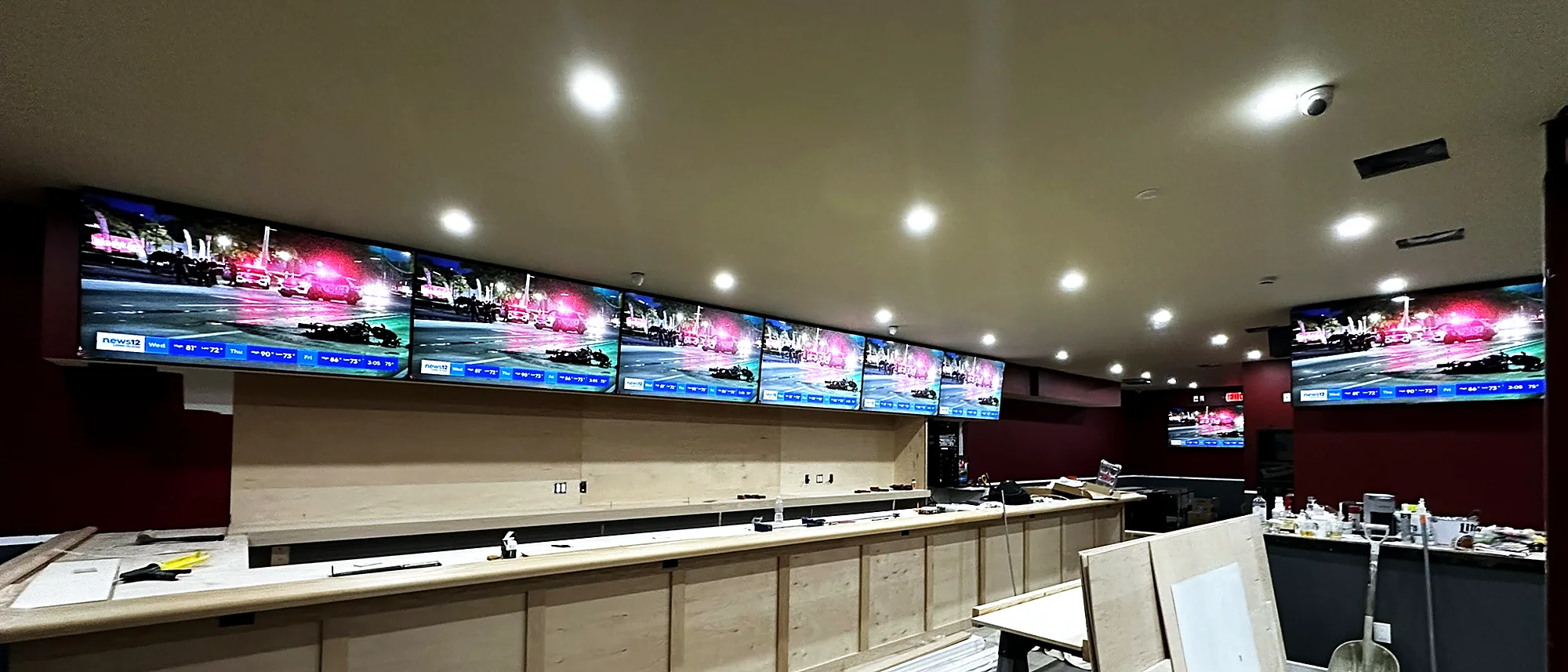
Hospitality is where most of our named work is, and it is unforgiving in a useful way: a system that is confusing gets abandoned within a month, and you find out immediately. We would rather scope the room properly than sell you more equipment than the room can be run with.
What goes in
Scoped for the room, not off a price list.
Certified on the platforms this uses
- Multi-TV distribution — one rack feeding every screen, so a screen is a destination rather than its own box of tricks
- Zoned audio — the bar, the dining room and the patio at their own levels, because they are not the same room
- DirecTV, cable and streaming sources centralised and labelled at the rack
- One control interface a bartender can use without being trained on it
- Outdoor-rated speakers and displays for patios and rooftops
- DMX-controlled lighting that changes with the night, run from presets rather than a laptop
- Acoustic treatment where the room, not the system, is what makes it hard to talk in
- Networking underneath all of it, segmented so the point-of-sale is not sharing with the guest WiFi
Tell us what you're trying to solve.
Free on-site estimates across Suffolk and Nassau County. We look at the space and tell you what it needs — and what it doesn't.
System down and need service now? Call (949) 969-3345 — Monday – Friday, 10am – 6pm.