
Whole-Home Audio & Invisible Speakers
Whole-home audio has quietly become a collection of wireless speakers that each need their own app, drop off the network at different times, and cannot be made to play the same thing reliably. A distributed system solves that differently: wired zones, an amplifier per zone, and streaming built into the system rather than borrowed from whoever's phone is nearest. The speakers themselves are the part people notice, and the good news is how little there is to notice.
What’s included
- Zone design worked out room by room — how many zones, what plays where, and who controls each one
- Invisible in-wall and in-ceiling speakers that are skimmed and painted over with the surface, from TruAudio's Wraith series
- Frameless architectural in-ceiling speakers that sit nearly flush and read as a vent rather than a speaker
- Compact in-ceiling speakers sized like a downlight, so they line up with the lighting instead of fighting it
- In-ceiling subwoofers matched to the ceiling speakers around them, for zones with no floor or wall space to give up
- Streaming zone amplification including VSSL, with AirPlay 2, Chromecast, Spotify Connect and Bluetooth on one input list
- Wired speaker infrastructure, home-run and labelled, sized for the amplification rather than for whatever was on the truck
- Keypads, panels and phone control, with permission levels so a guest zone cannot be reconfigured by accident
- Integration with existing control platforms, so audio joins lighting and shades rather than living in its own app
Equipment
Speakers that disappear, and what drives them.
We are authorized Origin Acoustics, TruAudio and VSSL dealers, which is what lets us start from what a room needs rather than from what is in a box. The choice usually runs along one axis: how completely the speaker has to vanish, and what that is worth in the room in question.
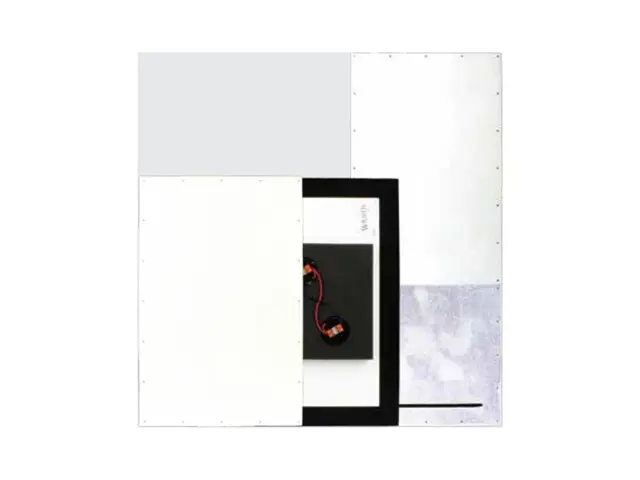
Invisible series
TruAudio Wraith WR24 / WR40
Flat exciter panels that mount inside the wall or ceiling and are skimmed and painted over with the surface. Not a low-profile grille — nothing at all. The WR40 does the same for bass.
- WR24
- 50 W · 70 Hz – 18 kHz
- WR40 sub
- 150 W max · 35 – 150 Hz
- Dispersion
- 180° × 180°
- Depth
- 2.2" (56 mm)
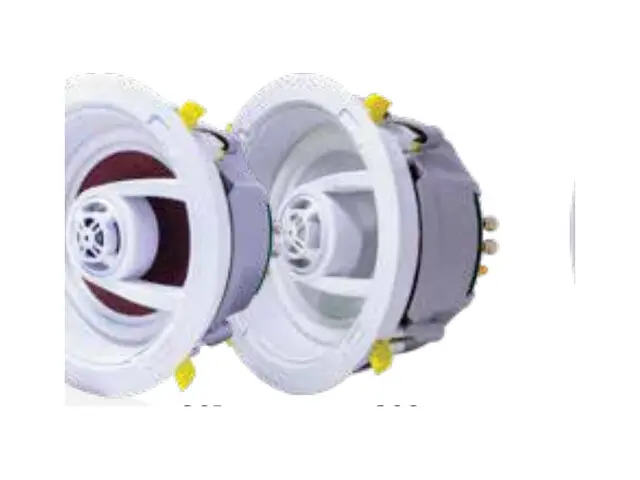
Frameless in-ceiling
TruAudio Ghost Series
Where invisible is more than the job needs. The frameless grille sits nearly flush and the reveal is 40 per cent shallower than the previous generation, so it reads as a vent rather than a speaker. The 9-inch model is a three-way with an aimable tweeter and midrange.
- Drivers
- 7" and 9" woofers
- 9" model
- 3-way, pivoting tweeter
- Grille
- Frameless, magnetic
- Backbox
- Vented, protective
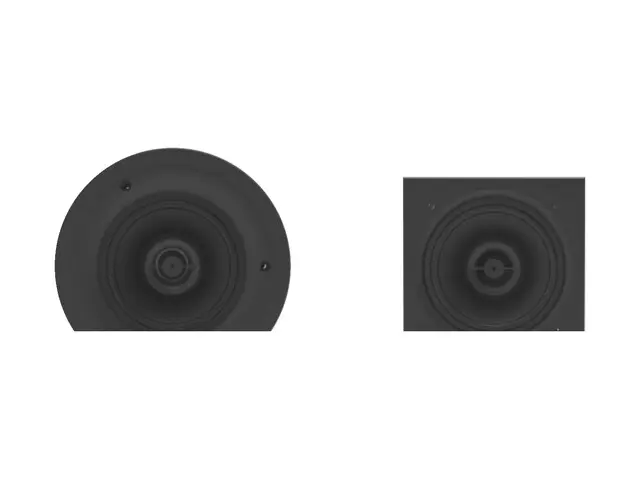
Compact in-ceiling
TruAudio LF Series
About the size of a downlight, round or square, so it lines up with the lighting instead of fighting it. For kitchens, bathrooms, hallways and offices where a full-size speaker is more than the room needs.
- Driver
- 4" coaxial, 0.5" tweeter
- Power
- 5 – 50 W · 8 Ω
- Cutout
- 5.6" round / 4.3" square
- Grille
- Frameless, magnetic
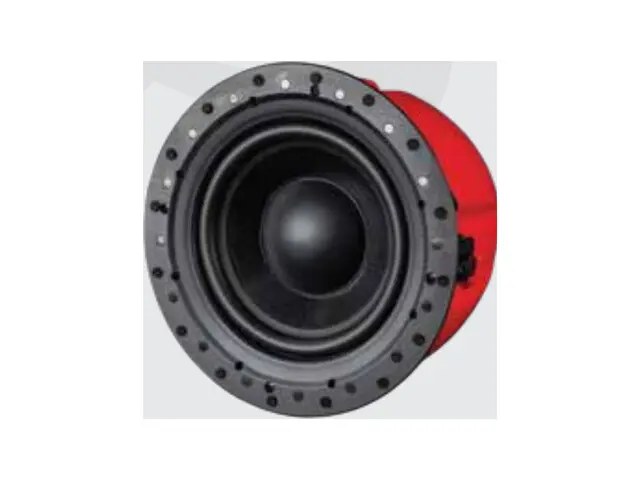
In-ceiling subwoofer
TruAudio IC-SUB-8
Bass in a zone that has no floor space and no wall to give up. Fits the same 8-inch cutout as the ceiling speakers around it and wears the same grille, so it disappears into a run rather than announcing itself.
- Driver
- 8" polypropylene
- Power
- 75 – 150 W · 8 Ω
- Response
- 38 – 140 Hz
- Cutout
- 9.4" (238 mm)
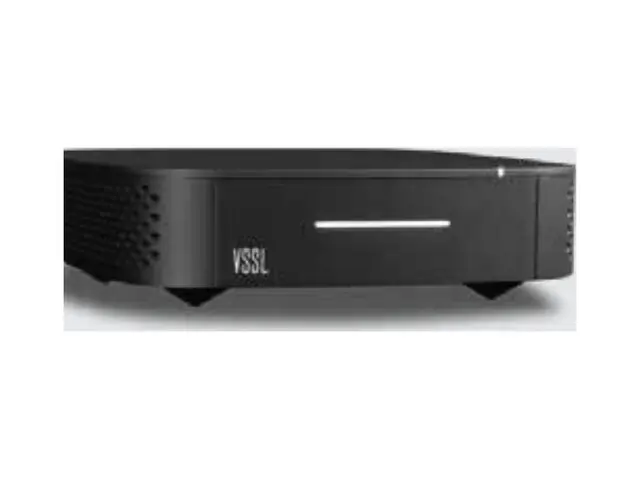
Streaming zone amplifier
VSSL A.1x
One amplifier per zone with the streaming built in, so a room does not depend on somebody's phone staying connected. AirPlay 2, Chromecast, Spotify Connect and Bluetooth all arrive at the same input list.
- Output
- 35 W @ 8 Ω · 50 W @ 4 Ω
- Streaming
- AirPlay 2, Chromecast
- Sub out
- Crossover 55 – 200 Hz
- EQ
- 7-band adjustable
Product images above are supplied by the manufacturer and show the equipment itself, not our installations. Photographs of our own work are on The Work. TruAudio, Origin Acoustics, VSSL and their product names are trademarks of their respective owners.
Speakers You Are Not Supposed to See
Invisible speakers mount inside the wall or ceiling and finish flush with the surface. They are skimmed, taped and painted or plastered over along with the rest of the wall, and when the room is done there is nothing to see — no grille, no bezel, no outline.
The technology is different from a conventional speaker: the panel itself is driven and radiates through the finished surface, which is why dispersion is so wide and why there is nothing to point at a listening position. For rooms where a visible speaker is not acceptable, and for owners who have been told the choice is between good audio and a clean wall, they are usually the answer.
They are unforgiving of a bad install, which is the part that matters. The mounting has to be right relative to framing, the surface treatment has to be done to the manufacturer's specification, and the position has to be decided before anything is closed up because there is no adjusting it afterwards. This belongs in the rough-in conversation with the builder, not after the painter has left.
When Invisible Is More Than the Job Needs
Invisible speakers cost more and demand more of the installation, and in a lot of rooms they are not the right call. A frameless architectural in-ceiling speaker sits nearly flush with a magnetic grille and no visible trim ring, and in a painted ceiling it reads as a vent. Most people stop noticing it within a week.
Driver size follows the room rather than the budget. A great room wants larger woofers and the aimable tweeter that a three-way design gives you, so the sound arrives at the seating rather than at the floor. A hallway or a bathroom wants the opposite — something the size of a downlight that lines up with the existing lighting layout.
Getting the layout right matters more than the speaker. Ceiling speakers spaced by eye produce loud spots under each one and thin patches between them; spaced against ceiling height and listening height they produce even coverage at a level nobody has to think about.
Zones, Not Speakers
The useful unit of a distributed system is the zone, not the speaker. A zone is a space that gets its own source and its own volume — the kitchen, the primary suite, the patio — and the design question is how many of those you actually want rather than how many speakers go in the ceiling.
An amplifier per zone with streaming built in is what makes this behave. The zone holds its own connection to AirPlay, Chromecast, Spotify Connect or Bluetooth, so it does not depend on a phone staying in range, and a source can be handed between zones without anybody re-pairing anything.
Where a zone needs bass and has no floor or wall to spare, an in-ceiling subwoofer goes into the same run as the speakers and wears the same grille. It is the difference between background music and a kitchen that sounds like a room rather than like a ceiling.
The Wire Is the Part You Cannot Redo
Everything above depends on cable that was run before the walls closed. Speaker cable to each location, home-run back to where the amplification will live, sized for the distance and the load rather than for what was on the truck, and labelled at both ends so the next person can work on it.
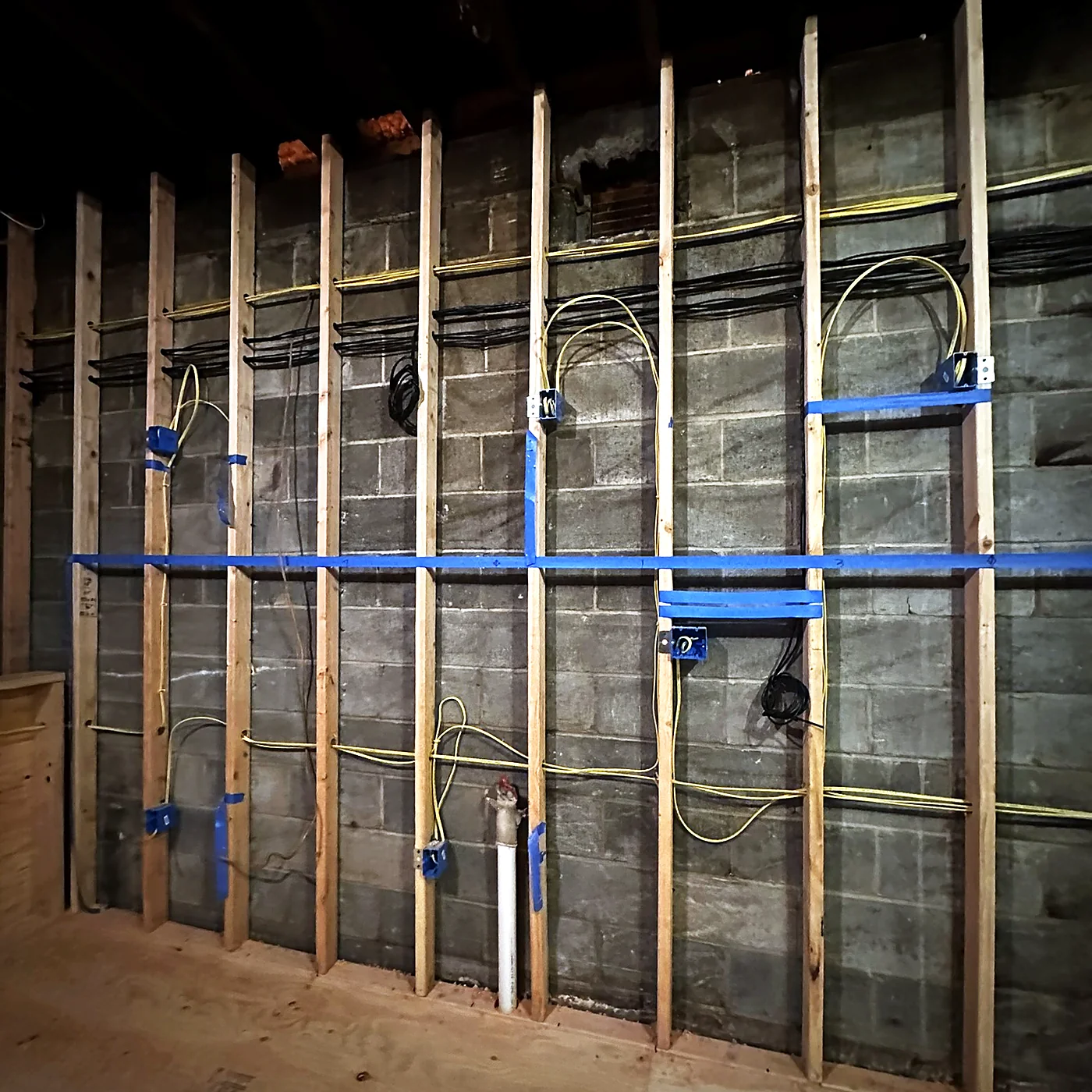
That is why this conversation belongs at rough-in. Running cable to a room somebody is not sure about costs almost nothing at that stage; adding it afterwards means opening finished surfaces. We would rather put a capped pathway into three rooms you may never use than have the answer be no in two years.
It also decides where the equipment lives. A ventilated rack in a closet or utility space, with the zones home-run to it, means adding a zone later is a patch rather than a project — and means nobody has amplifiers heating up inside a cabinet in the living room.
Common questions
Whole-Home & Distributed Audio: what clients ask before they book
Are invisible speakers actually any good, or is it a compromise?
They are a genuine trade rather than a gimmick. A quality invisible speaker installed correctly is very close to a good in-wall for music and television, and the difference is not something most people notice in a real room. Where they lose is at high output and in the deepest bass, which is what a subwoofer is for. The bigger risk is the installation, not the speaker: they must be positioned and finished to specification before the wall is closed, because nothing can be adjusted afterwards.
Can this be retrofitted, or does it need construction?
Conventional in-ceiling and in-wall speakers retrofit into finished rooms routinely — the cable is the work, not the speaker. Invisible speakers are much harder to retrofit well, because the surface has to be finished over them, so they are best scoped during a renovation or a build. We will tell you honestly which rooms are practical and which are not worth the disruption.
How is this better than wireless speakers in each room?
Reliability and control, mostly. A wired zone does not drop off the network, does not need re-pairing, and does not depend on which phone is nearest. It also lets the speakers be invisible, which no wireless speaker can be. Where wireless makes sense is a single room you might change your mind about — for a whole house it becomes several apps and a lot of small annoyances.
How many zones does a house actually need?
Fewer than most quotes suggest. The useful test is whether two spaces genuinely need different music at different volumes at the same time. Kitchen, primary suite, outdoor and a main living space cover most households; adding a zone per room sounds thorough and mostly adds cost and control complexity nobody uses.
Can the outdoor speakers be part of the same system?
Yes, and they should be — the patio is simply another zone. The equipment differs because outdoors needs weather-rated speakers and usually 70 volt distribution over distance, but it lives on the same amplification, the same sources and the same control as the inside.
Will it work with the control system we already have?
Usually. If the platform can control audio over IP or serial, the zones become part of the same presets as lighting and shades, so an evening setting is one action. Which specific hardware integrates cleanly varies by model, and we confirm that during design rather than promising it up front.
Rooms we do this in
Related services
Home Theater & Media Rooms
Dedicated theaters and everyday media rooms — designed around the seating and the room, not around a box of equipment, and controlled by something anyone in the house can use.
Outdoor Living & Landscape Lighting
Audio, video and lighting for the parts of a property people actually spend time in — patios, pools, decks and yards — designed for the conditions they live in.
Q-SYS & Control Systems
Q-SYS design, DSP configuration and control programming — including custom plugins we write ourselves — so audio, video, lighting, cameras and climate answer to one interface instead of six remotes.
Tell us what you're trying to solve.
Free on-site estimates across Suffolk and Nassau County. We look at the space and tell you what it needs — and what it doesn't.
System down and need service now? Call (949) 969-3345 — Monday – Friday, 10am – 6pm.